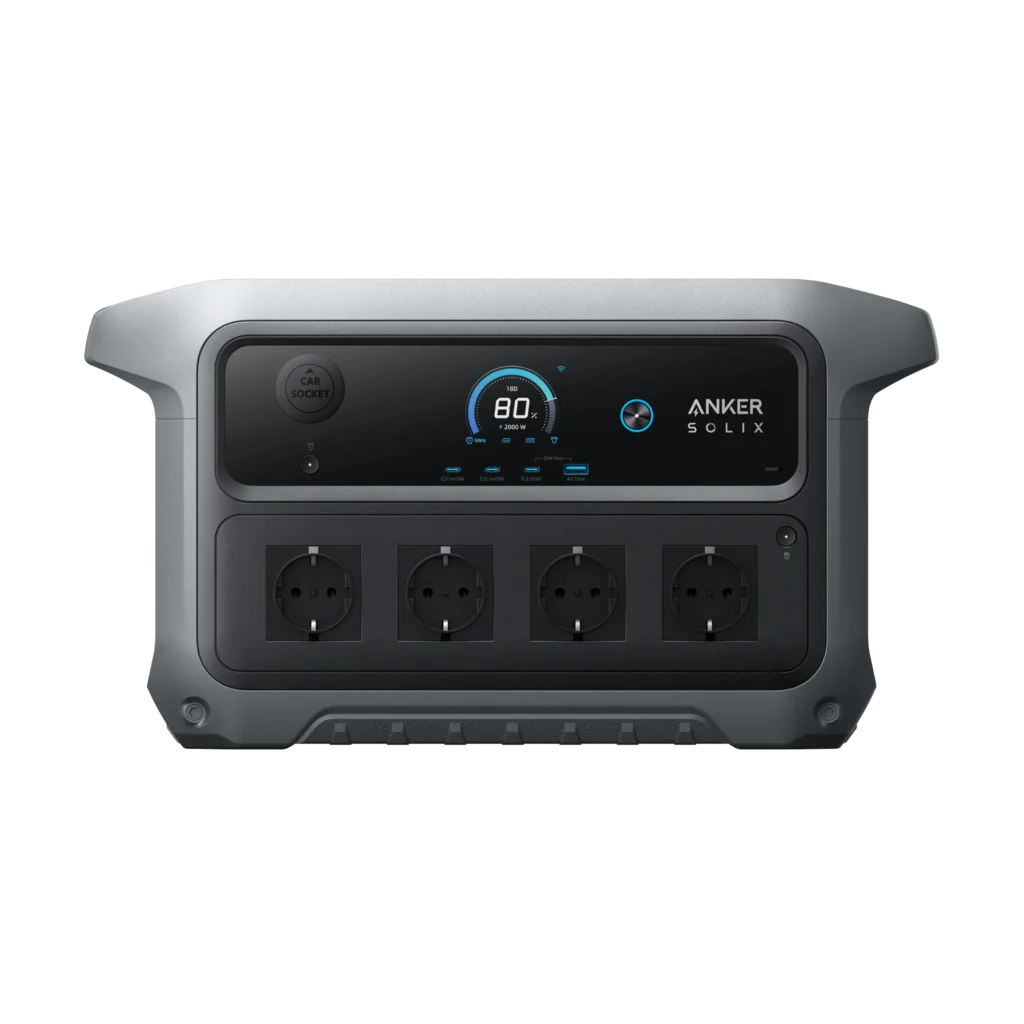
The Anker SOLIX C1000 Gen 2 is a portable power station with a 1,024 Wh battery and 2,000 W of continuous AC output (3,000 W peak), according to Anker’s published specifications. It suits short outages, small appliances and portable use. It cannot be expanded with extra battery capacity, so buyers who expect to need more energy later should look at larger or expandable models.
What the main numbers mean
Capacity (1,024 Wh) is the energy stored. In theory a 100 W device could run for about ten hours, and real runtime is lower because of conversion losses.
Output (2,000 W continuous, 3,000 W peak) is how much power it can deliver at once. Add up the wattage of everything you plan to run together and keep the total under 2,000 W. Motors and compressors can draw more for a moment when they start.
Solar input (600 W maximum, 60 V maximum) is the most solar power it can accept. Anker says a full recharge at this input takes about 1.8 hours, which assumes strong sun and a matching panel setup.
How long could it run common devices?
These are estimates, not measurements. Method: capacity (1,024 Wh) × 85% efficiency ÷ the device’s draw.
| Device | Assumed draw | Estimated runtime |
|---|---|---|
| Mini fridge | 60 W | about 14 h 30 min |
| CPAP machine | 50 W | about 17 h 24 min |
| Laptop | 60 W | about 14 h 30 min |
| Wi-Fi router | 12 W | about 72 h 32 min |
| Television | 100 W | about 8 h 42 min |
| Coffee maker | 1,000 W | about 52 min |
Real draw varies by model. A refrigerator’s compressor cycles on and off, so its average use can be lower than its running wattage, but start-up surges matter. Check the label on your own device and try it in the runtime calculator.
Charging options
Wall (AC): standard charging is listed at up to 1,200 W. UltraFast mode raises AC input to 1,600 W, and Anker says that gives a full recharge in about 49 minutes. It has to be switched on in the Anker app. Anker’s FAQ says speed depends on battery temperature: UltraFast activates above 68°F (20°C), and charging between 32°F and 68°F is much slower. Anker also advises using it only when necessary to prolong battery life.
Solar: up to 600 W input (60 V maximum).
Grid and solar together: Anker says both can charge the unit at the same time, with solar prioritized and AC supplying the remainder.
Ports and outputs
Anker’s specifications list AC output up to 2,000 W at 120 V, a 12 V car socket (10 A, up to 120 W), a USB-C port rated up to 140 W and a USB-A port rated up to 12 W. Anker describes 10 output ports in total. The product page does not list exact port counts by type, so check the manual before buying if you need a specific number of outlets.
UPS function
Anker lists a UPS switchover time under 10 ms, which is designed to keep connected equipment powered if wall power drops while the unit is plugged in. Whether that is enough for a particular device, such as a desktop computer or medical equipment, depends on the device. This site cannot give medical advice, so check with the device’s manufacturer.
How it compares with Anker’s older C1000
Anker’s own comparison table lists the older C1000 at 1,056 Wh, 1,800 W output, 20 ms UPS and expandable capacity. The Gen 2 is listed at 1,024 Wh, 2,000 W, 10 ms UPS and no expansion. In short, Anker traded expandability for higher output and faster charging. These are the manufacturer’s figures.
What a spec sheet can’t tell you
We compare published specifications and have not tested this unit. A spec sheet cannot show fan noise in daily use, how well the app works, efficiency under different loads or how the unit ages. Anker lists 20 dB operation but does not state the conditions behind that figure. Before buying, read independent test results and check current availability and warranty terms on Anker’s site.
Frequently asked questions
Can the Anker SOLIX C1000 Gen 2 be expanded?
No. Anker says expansion was left out to keep the unit smaller and lighter, and suggests the older C1000 for people who need expandable capacity.
How long does it take to recharge?
Anker states about 49 minutes to 100% with UltraFast AC charging enabled, and about 1.8 hours with 600 W of solar input. Both depend on conditions such as battery temperature and available sunlight.
Can it run a refrigerator?
Possibly, depending on the refrigerator. Check the wattage on its label. A refrigerator can draw more for a moment when the compressor starts, and Anker lists 3,000 W peak output. A larger refrigerator with a higher draw will run for less time than the 60 W mini fridge example above.
Can it charge from the wall and solar at the same time? Yes. Anker’s FAQ says it can, with solar prioritized and AC supplying any remainder.
Does it have an app?
Yes. Anker lists app control, including a time-of-use mode meant to shift charging toward cheaper electricity periods.